
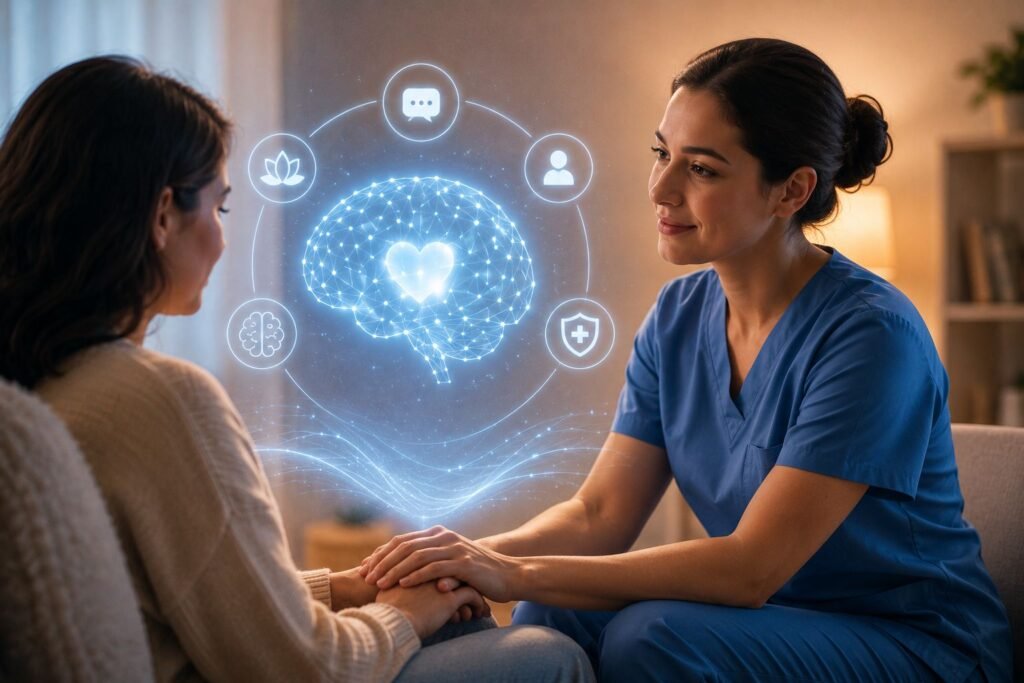
Mental health care has been primarily dependent on human interaction—hearing, comprehending, and reacting with the help of an empathic understanding. The use of Large Language Models (LLMs) in the form of AI-enabled chat systems in psychiatric care might, at the outset, seem like an oxymoron or contradictory in nature. After all, could a machine really be part of a field that is based on emotional intelligence?
However, LLMs are being gradually integrated in psychiatry and mental health nursing across various healthcare environments, not as a means of replacing nurses but as an aid. LLMs, therefore, are slowly but surely becoming the instrument through which health care is transformed from the perspective of the mental health field—from documentation to patient education and clinical decision support. Nurses should be acquainted with these changes from a nursing perspective in order to be prepared ethically and practically for their use in care.
How LLMs Can Support Psychiatric Nursing
LLMs can work through enormous amounts of data that involve language very quickly. In such a setting as a psychiatric one, where communication plays a key role, it opens up a lot of very promising possibilities.
1. Supporting Clinical Documentation
Psychiatric nurses frequently experience a heavy workload connected with documentation. The introduction of LLM-driven devices in this domain can be highly beneficial in these ways:
• Producing progress notes
• Summarising patient conversations
• Structuring assessment data
2. Enhancing Patient Education
Quite often, patients fail to understand the complicated psychiatric terms or even their own treatment plans. LLMs are:
• Able to explain illnesses with easy terms
• To give information about the drug
• To repeating helping methods that are talked in the therapy
If healthcare providers rightfully utilize them, this will surely enhance patient’s comprehension and their following of the treatment.
3. Early Identification and Risk Support
Any repetitive statement of a feeling such as despair or anxiety in a patient’s conversation is something that LLMs can help (by analyzing communication) pinpoint and then highlight this concern for doctor’s clinical evaluation. Thus, this tool also provides a kind of prevention support, especially capable of detecting first signs in groups of people highly exposed to the risk.
4. Nurse Education and Decision Support
Students of nursing and young nurses may use LLMs as a resource of information if they engage them in studies by:
• Clarifying medical topics
• Suggesting latest-research-based guidelines
• Leading reflective-empathy practice
Used properly, they contribute to the growth of self-assurance as well as knowledge.
Practical Uses of LLMs in Everyday Nursing Practice
In reality, LLMs are most productive as an assistant in psychiatric nursing, the front line practitioner should always be the decision-maker.
Some practical examples of how LLMs might be useful include:
• Writing discharge teaching manuals
• Developing mental health awareness campaigns
• Giving an explanation of care plan.
The nurse is still the one who has to check, change, and authorize every output.
The Future of Psychiatric Nursing in an AI-Supported World
LLMs should not substitute psychiatric nurses; rather, these should reshape their work.The caring job of the future will most likely mix hi-tech and old-fashioned human kindness.As developers further advance these instruments, nurses knowledgeable in their ethical use will be in a position to:
• Offer care that is efficient and patient-centred
• Lessening work overloads
• Improving the general knowledge about mental health
Machines will not be the ones to lead the way in the future of psychiatric care but nurses who know how to handle the tech without losing their empathy. If done properly, LLMs can empower the mental health field and open the road towards the better outcomes of both patients and professionals.